


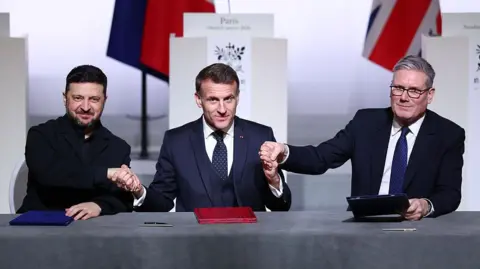
The UK and France have signed a statement of purpose concerning the deployment of troops in Ukraine should a peace deal be concluded with Russia, the UK Prime Minister, Sir Keir Starmer, has stated.
Subsequent to discussions with allied nations in Paris, he indicated that the UK and France would "create defense centers in various parts of Ukraine and construct protected structures for weapons and equipment" to deter any future invasion.
The allied nations also put forward that the America would take the lead in monitoring a halt in hostilities.
Russia has on multiple occasions cautioned that any non-Ukrainian military in Ukraine would be considered a "legitimate target", but has as yet not commented on this new development.
Context and Ongoing War
Moscow's leader Vladimir Putin launched a major offensive of Ukraine in the start of last year, and Russia presently controls approximately 20% of Ukraine's sovereign soil.
"This represents an essential component of our vow to stand with Ukraine for the duration," stated Starmer.
Top officials and high-ranking officials from the "Partner Group" participated in Tuesday's talks.
He stated at a combined announcement, he further said: "It creates the pathway for the legal framework under which British, French, and partner forces could operate on the ground in Ukraine, protecting Ukraine's skies and seas, and regenerating Ukraine's military for the time to come."
The UK prime minister added that Britain would take part in any US-led monitoring of a potential ceasefire.
Security Guarantees and Diplomatic Positions
Lead US negotiator Steve Witkoff remarked that "durable defense assurances and strong reconstruction vows are critical to a permanent resolution" in Ukraine – mentioning a central requirement made by Kyiv.
Witkoff noted the coalition had "substantially agreed on" their work on finalizing such guarantees "so that the people of Ukraine know that when this conflict ends, it ends permanently."
The former US envoy, former American President Donald Trump's representative, also took part in the negotiations.
Separately, French President Emmanuel Macron said that Ukraine's partners had made "major advances" at the talks.
He added that "strong" safety pledges for Kyiv had been agreed in the case of a possible ceasefire.
President Volodymyr Zelensky stated that a "major advance" had been made in the talks, but added that he would only consider efforts to be "sufficient" if they resulted in the conclusion of the fighting.
Earlier, he said a peace agreement was "90% ready". Finalizing the remaining 10% would "shape the outcome of the agreement, the fate of Ukraine and Europe".
Unresolved Issues
- Land and defense assurances have been at the center of ongoing disputes for negotiators.
- The Russian President has often said that Ukraine's forces must pull back from all of Ukraine's eastern Donbas region or Russia will seize it, rejecting any compromise over how to conclude the war.
- Zelensky has so far rejected giving up any territory, but has floated the idea that Ukraine could pull back its forces to an mutually accepted point – but only if Russia does the same.
Russia currently controls approximately 75% of the Donetsk oblast and some 99% of the adjacent Luhansk. The two regions form the area of the Donbas.
The earlier US-led comprehensive proposal that was circulated to the media last year was perceived by Kyiv and its partners in Europe as being heavily skewed in Russia's direction.
This led to a period of focused diplomacy – with Ukraine, the US and European leaders trying to revise the draft.
The previous month, Ukraine sent the US an updated 20-point plan – as well as distinct documents detailing prospective defense assurances and arrangements for Ukraine's reconstruction, he said.


